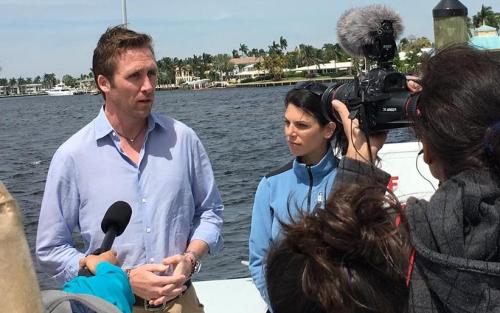
Why is most of Broward County left out of the U.S. Fish and Wildlife Service’s (FWS) Endangered Species Act, Loggerhead Sea Turtle critical habitat beaches proposal?
Reef Rescue has signed on with 34 other organizations urging FWS to include habitat protection for Loggerhead Sea Turtles to Ft. Lauderdale beaches as well as to all of Broward County, Florida.
The organizations, representing millions of members in the Southeast and across the nation, are writing to support proposed regulations that designate critical habitat protections for Loggerhead Sea Turtles along 739 miles of coastline in North Carolina, South Carolina, Georgia, Florida, Alabama and Mississippi that cover 84 percent of the loggerhead sea turtle nesting areas.
In addition to the above area, several beaches that provide important nesting habitat for Loggerhead Sea Turtles are not included in the proposed FWS rule, such as the beaches extending southward of Hillsboro Inlet in Broward County, Florida. We urge the FWS to include these and other important nesting beaches in the critical habitat designation.
There is still time for the public to comment on the critical habitat proposal. The final deadline is Friday, May 24. Written comments and information concerning the proposal can be submitted by one of the following methods:
Federal eRulemaking Portal: http://www.regulations.gov. Follow the instructions for submitting comments to Docket No. FWS–R4–ES–2012–0103;
or
U.S. mail or hand delivery: Public Comments Processing, Attn: FWS–R4–ES–2012–0103; Division of Policy and Directives Management; U.S. Fish and Wildlife Service; 4401 N. Fairfax Drive, MS 2042–PDM;, Arlington, VA22203.
Army Corp says blasting and dredging for the 100 million dollar Port of Palm Beach expansion will adversely impact whales, sea turtles, sawfish, corals, seagrass, fishing and diving.
The project expected to last two years with construction 24 hours a day, seven days a week will produce silty water and dead sea life in the vicinity of Peanut Island and the Blue Heron Bridge.
Reef Rescue is in the process of reviewing the massive EIS presented at a public meeting on May 9th. See Palm Beach Daily News and the Palm Beach Post.
Biological Assessment to National Marine Fisheries Service Lake Worth Inlet Widening and Deepening Palm Beach County, Florida
Action Area
The project proposes to widen and deepen Lake Worth Inlet navigation channel. The authorized project depths are as follows: entrance channel to a depth of 37 feet (from STA 30+00 to STA 47+00); from the inner channel to a depth of 33 feet; from the turning basin to a depth of 33 feet; and to a depth of 25 feet in the extended turning basin located north of the existing project basin. The existing settling basin and the extended settling basin are maintained at 35 feet and are located adjacent to the entrance channel and north jetty.
Where hard rock is encountered, the Corps anticipates that contractors could utilize other methods, including confined blasting or large cutterhead dredge equipment to pre-treat the rock prior to removal.
Protected Species Included in this Assessment
The Corps has reviewed the biological, status, threats and distribution information presented in this assessment and believes that the following species will be in or near the action area and thus may be affected by the proposed project: the five sea turtle species; humpback and sperm whales, Johnson’s seagrass and smalltooth sawfish.
Six species of endangered marine mammals may be found seasonally in the waters offshore southeastern Florida. The Corps believes that only the sperm and humpback whales may be adversely affected by activities associated with the proposed action. These effects would be a result of acoustic harassment.
The endangered Florida manatee (Trichecus manatus) and the American crocodile (Crocodylus acutus) also occur with the action area and the Corps has initiated consultation with the U.S. Fish and Wildlife Service concerning the effects of the proposed action on these species.
Effects of the Action on Protected Species.
As previously stated, the Corps believes that the loggerhead turtle, green turtle, smalltooth sawfish and Johnson’s seagrass have the potential to be effected by the proposed dredging project. The project may have the following adverse impacts on listed/protected species are:
-direct effect of blasting in the turning basin.
-direct effect of dredging activities
-indirect effects
Direct Effects
Blasting
Sea turtles Specific information regarding the likely direct impact of explosives on sea turtles is not available. Studies regarding the impacts of relatively minuscule explosives on humans noted that minor injuries such as small bruises or perforations of the intestinal tract occasionally occur well beyond ranges in which human lung damage could occur (Christian and Gaspin, 1974). Christian and Gaspin (1974) note that these minor injuries could become serious if left unattended. Sea turtles with untreated internal injuries would have increased vulnerability to predators and disease. In the Environmental Impact Statement prepared by the Navy to consider the effects of explosives used in shipshock tests, nervous system damage was cited as a possible impact to sea turtles caused by blasting. Damage of the nervous system could kill sea turtles through disorientation and subsequent drowning.
Unconscious sea turtles that are not detected, removed and rehabilitated likely have low survival rates.
Blasting will affect nearby finfish and invertebrates and cause short-term changes to the physical characteristics of the benthos. Fish and invertebrates killed or injured by the blasting may provide a short-term enhancement of foraging opportunities for green and loggerhead sea turtles. Through new recruitment and local migrations, finfish and benthic invertebrates are expected eventually to repopulate the affected area.
Smalltooth Sawfish
Blasting rock underwater produces a pressure wave in water that can produce fish mortality. Different types of fish have different mortality thresholds. This depends on whether the fish dwell near the surface, on the bottom, or in between.
The magnitude of the pressure wave generated in greatly affected by the stemming of the blastholes, distance between holes, and the delay time of the holes.
Normally, mortality occurs in the range of 150-psi overpressure for fish. In practice this is a 75foot to 100-foot radius around the blasting area.
Johnson’s seagrass Areas of Johnson’s seagrass adjacent to construction activities may be temporarily affected by increased turbidity and lower water clarity during construction
Reef Rescue new testing equipment arrived just in time to catch contractor dredging violations.
In February we unpacked and calibrated our new turbidity meter (paid for with your donations) and put it right to work monitoring contractor permit compliance. Turbidity standards are built into the dredging permits by FDEP to protect our nearshore coral reefs from siltation. Reef Rescue volunteers were onsite daily monitoring the Palm Beach Inlet, Boynton Inlet and Delray Beach dredging projects.
Volunteers immediately began to witness violations and report their findings to FDEP. They found and documented boulders pumped on the beach in Palm Beach, making it unsuitable for sea turtle nesting. The Army Corp of Engineers ordered the contractor back to remove the rocks. After the first cleanup was performed improperly volunteers reported them a second time and they were forced to go back and do it again.
After finishing the Palm Beach Inlet dredge the contractor towed their equipment away and dragged cables across a three mile swath of coral reef. Local dive boats spotted the damage and turned them in to the FDEP. Under the 2009 Florida Coral Reef Protection Act, the contractor faces hundreds of thousands in fines, must repair the damage and pay for monitoring of the restoration for the next ten years.
Next the dredge arrived in Delray Beach on March 2nd to nourish 1.9 miles of beach. On March 3rd we caught them violating the projects turbidity standard. During the 27 days of the project 12 turbidity violations were documented, forcing the project to shut down on several occasions. On April 9, a joint Reef Rescue and FDEP site inspection found turbidity levels far above permitted levels. Volunteer dives are now in the process of monitoring the nearby reefs for any sign of project related damage.
You can learn more about these and other issues by following the updates on the Reef Rescue Blog http://reefrescue.wordpress.com/ .
What is the best way to stay in touch with Reef Rescue happenings?
. Reef Rescue on Facebook, where we post updates on a nearly daily basis.
And at the Reef Rescue Coral Reef Blog, where you will find more in depth reporting on reef related issues updated several times a month.
Here is some local news coverage from just the last week:
~~~~~~~~~~~~~~~~~~~~~~~~~~~~~~~~~~~~~~~~~~~~~~~~~~~~~~~~~~~~~~~~~~~~~~~~~~~~~~~~~~~~~~~~~~~~~~~~ Two great fundraising events to show your support for Reef Rescue are coming up: Party to Help Florida Reefs Fundraiser May 18th, 2013
A fundraiser for two very special organizations that help protect the health of our Florida Reefs. We all want to keep diving on beautiful coral reef, so lets make sure to support Reef Rescue and Vone Research in what they do to keep our reefs thriving.
.
Fundraiser will be from1 to 6 pm at Hurricanes in Delray Beach
Located at 640 E. Atlantic Ave.
.
We will have food, 2 for 1 drink special, live band, and raffles on items from Force-E, Aqua Lung, Mares, Diver’s Alert Network and more.
.
All proceeds will go to Reef Rescue and Vone Research to help them fund their organizations to keep up the good work!
Pre-buy your tickets for this event at any Force-E Scuba Centers= $10, plus get one FREE raffle ticket at the door…. Or Buy your tickets at the door $12 And
The always popular Kayak-a-thon Fundraiser The date is set for the 8th annual Kayak-a-thon fundraiser.
On Saturday June 1, 2013, kayakers will paddle their way along a 7 mile course from the Riviera Beach Marina to Munyon and Peanut Islands then back to the marina.
This annual event is one of the most exciting fundraising activities of the year for Reef Rescue. Not only does the Kayak-a-thon help raise funds to support Reef Rescue coral reef conservation projects, but it also brings together our family of supporters for a fun filled day of outdoor activity.
Like a walk-a-thon, kayakers raise money by collecting donations or pledges for completing the predetermined course. It is similar in format to other physical activity based fundraising events such as marathons and cycling races, but this low intensity, non-competitive event is ideal for mobilizing broad-based community support.
Click here to learn more, see photos and watch video from previous years events.
Kayakers signup now! http://www.kayakathon.com/
If you do not have a kayak there are some available, but the supply is limited, so act fast.
Go to: www.kayakathon.com
If you have any questions about the event or how your organization can become involved contact Brian Lee (561) 843-4109
.
Town of Palm Beach must build coral nurseries and transplant 5,000 coral colonies as penalty for past reef damage.
In April 26, 2013, correspondence The Florida Department of Environmental Protection (FDEP) directed the Town of Palm Beach to build artificial reefs and coral nurseries to offset reef damage caused by the 2003 and 2006 Mid-Town beach renourishment projects.
[Editors note: there have been many recent news reports of reef damage related to Great Lakes Dredge and Dock’s, 2013 Palm Beach Inlet and Delray Beach renourishment projects. This article reports on mitigation to compensate for reef burial from Palm Beach’s 2003 and 2006 projects]
As reported in our December 2009, Reef Rescue Blog, the FDEP rejected assertions from the Town of Palm Beach’s consultants (CPE) that the Mid-Town beach renourishment projects had no impact on the nearby coral habitat. Prompted by complaints from volunteer divers (sound familiar) that as much as of 26 acres of Breaker’s Shallow Reef was buried by beach renourishment sand the FDEP directed Palm Beach to reassess their findings. New consultants were hired and a new report issued – this time the consultants found buried reef.
As a condition for FDEP to allow future renourishment projects in the area, Palm Beach must build acres of mitigation reef, transplant 5,000 coral colonies and monitor the nurseries for the next 10 years. Project costs are expected to exceed many millions of dollars.
UPDATE, April 29 Palm Beach Daily News: The reefs…have been destroyed, said Connie Gasque, a Palm Beach resident and member of Palm Beach County Reef Rescue. Gasque was one of the divers who discovered the damage and reported it to DEP. “A DVD from 2000 shows an absolutely viable reef with coral, octocoral, sponges and fish,” Gasque said. Now there is nothing. The Town of Palm Beach killed off a viable reef at Ballentines and the Cable Crossing.”
The date is set for the 8th annual Kayak-a-thon fundraiser. On Saturday June 1, 2013, kayakers will paddle their way along a 7 mile course from the Riviera Beach Marina to Munyon and Peanut Islands then back to the marina.
This annual event is one of the most exciting fundraising activities of the year for Reef Rescue. Not only does the Kayak-a-thon help raise funds to support Reef Rescue coral reef conservation projects, but it also brings together our family of supporters for a fun filled day of outdoor activity.
Like a walk-a-thon, kayakers raise money by collecting donations or pledges for completing the predetermined course. It is similar in format to other physical activity based fundraising events such as marathons and cycling races, but this low intensity, non-competitive event is ideal for mobilizing broad-based community support.
April 15, 2013 pumping at the Delray beach renourishment dredge project ended. Immediately the silt plumes, that at times covered miles of shoreline began to slowly clear. But the work of volunteer monitors is not over. Our focus now moves offshore to assess impacts to the nearby coral reefs.
During the 27 days of the project 12 permit violations were documented, forcing the project to shut down on several occasions. An April 9, joint Reef Rescue and FDEP site inspection found turbidity levels far above permitted levels.
Maximum permissible turbidity levels are written into the project permit to protect the coastal environment. Silt suspended into the water column by the project will ultimately settle out and degrade the hard bottom habitat, inhibiting settlement of corals, other invertebrates, and algae, and can suffocate and kill suspension-feeding invertebrates already present. The hard-bottom species at risk include all the octocorals and the elkhorn and staghorn corals, both on the Threatened Species list of the Endangered Species Act.” (Peterson, 2008).
We’re asking for help from the local scuba diving community.
Your observations and photos of project related reef siltation and degradation are important. Silt from this project has potential to impact Gulfstream Reef, Delray Ledge, Seagate Reef and Shark Reef. Contact Reef Rescue.
March 24, 2013, 9:00 AM, the silt plume from the Delray Beach renourishment project stretches along over two miles of shoreline and is clearly in violation of the project permit. Reef Rescue collected turbidity compliance samples on March 3rd, 5th, 17th and found permit violations. In each instance these data were reported to the FDEP compliance office. One month after the project began, today’s conditions are the worst to date; turning the nearshore environment into a sea of mud.
Where is the Department of Environmental Protection? Are they unwilling or incapable of enforcing the very permit they issued for this project.
The turbidity compliance permit requirement is not to exceed 29 NTU above background conditions. Today’s test results found silt levels at 87.5 NTU above background.
The dredge is now sitting 500 feet west of Seagate Reef, home of ESA protected staghorn coral and a location designated by the federal government as habitat critical for the survival of the species.
This is the same dredge that a few weeks ago laid waste to 3 miles of the Flower Gardens Reef and spewed rocks and coral rubble over 10 blocks of beach in the Town of Palm Beach.
The U.S. Fish and Wildlife Service (FWS) has identified island and mainland coastal beaches in six states to propose as critical habitat essential for the survival of Endangered Species Act (ESA) listed Loggerhead Sea Turtles.
The proposed critical habitat areas include 90 nesting beaches in coastal counties located in North Carolina, South Carolina, Georgia, Florida, Alabama and Mississippi. The proposed areas incorporate about 740 beach shoreline miles and account for approximately 84 percent of the documented nesting beaches within these six states.
Under the ESA, critical habitat identifies geographic areas that contain features essential for the conservation of a listed species. Critical habitat receives protection under section 7 of the ESA by requiring federal agencies to consult with the Service on federal actions that may affect critical habitat and by prohibiting federal agencies from carrying out, funding or authorizing the destruction or adverse modification of critical habitat.
This is a proposed designation.
FWS is seeking public comment before making a final determination.
If you’ll recall in 2009 the fed’s proposed designating Palm Beach reefs as critical habitat for the survival of ESA listed staghorn coral. The Town of Palm Beach successfully challenged the proposal and reefs offshore of Palm Beach were denied the federal habitat protections.
Case in point: had that area been designated for ESA protection as originally proposed, the recent Flower Gardens Reef dredge damage would now be under federal investigation.
It is important you submit your comments to FWS.
Written comments and information concerning the proposal can be submitted by one of the following methods:
Federal eRulemaking Portal: http://www.regulations.gov. Follow the instructions for submitting comments to Docket No. FWS–R4–ES–2012–0103; or
U.S. mail or hand delivery: Public Comments Processing, Attn: FWS–R4–ES–2012–0103; Division of Policy and Directives Management; U.S. Fish and Wildlife Service; 4401 N. Fairfax Drive, MS 2042–PDM;, Arlington, VA 22203.
Habitat threats:
For loggerhead sea turtle terrestrial habitat, the FWS has identified primary threats that may impact the habitat, thus necessitating special management or protection, into 12 categories:
(1) Recreational beach use (beach cleaning, human presence (e.g., dog beach, special events, piers, and recreational beach equipment));
(2) Beach driving (essential and nonessential off-road vehicles, all-terrain vehicles, and recreational access and use);
(3) Predation (depredation of eggs and hatchlings by native and nonnative predators);
(4) Beach sand placement activities (beach nourishment, beach restoration, inlet sand bypassing, dredge material disposal, dune construction, emergency sand placement after natural disaster, berm construction, and dune and berm planting).
(5) In-water and shoreline alterations (artificial in-water and shoreline stabilization measures (e.g., in-water erosion control structures, such as groins, breakwaters, jetties), inlet relocation, inlet dredging, nearshore dredging, and dredging and deepening channels);
(6) Coastal development (residential and commercial development and associated activities including beach armoring (e.g., sea walls, geotextile tubes, rock revetments, sandbags, emergency temporary armoring); and activities associated with construction, repair, and maintenance of upland structures, stormwater outfalls, and piers);
(7) Artificial lighting (direct and indirect lighting, skyglow, and bonfires);
(8) Beach erosion (erosion due to aperiodic, short-term weather-related erosion events, such as atmospheric fronts, northeasters, tropical storms, and hurricanes);
(9) Climate change (includes sea level rise);
(10) Habitat obstructions (tree stumps, fallen trees, and other debris on the beach;
nearshore sand bars; and ponding along beachfront seaward of dry beach);
(11) Human-caused disasters and response to natural and human-caused disasters
(oil spills, oil spill response including beach cleaning and berm construction, and debris cleanup after natural disasters); and
(12) Military testing and training activities (troop presence, pyrotechnics and nighttime lighting, vehicles and amphibious watercraft usage on the beach, helicopter drops and extractions, live fire exercises, and placement and removal of objects on the beach).
We’re asking divers and boaters to report any damage they observe to the coral reef ecosystem offshore of Delray Beach and Boynton.
March 2, 2013, the Texas, the largest dredge in the US, moved into position to begin the massive Delray beach renourishment project. The project which runs roughly from Linton Blvd. north to Atlantic Ave., will add 1.2 million cubic yards of sand to 1.9 miles of beach.